Publications
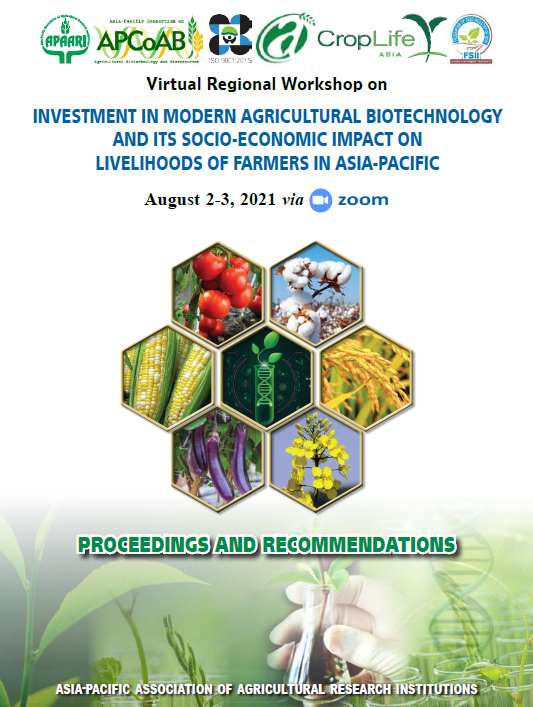 Investment in Modern Agricultural Biotechnology and its Socio-Economic Impact on Livelihoods of Farmers in Asia-Pacific – Proceedings and Recommendations
[download id=”38586″]
 Policy Paper on Scaling up the Adoption of GM Maize in Emerging Economies: Economic and Policy Lessons from The Philippines
[download id=”38400″]
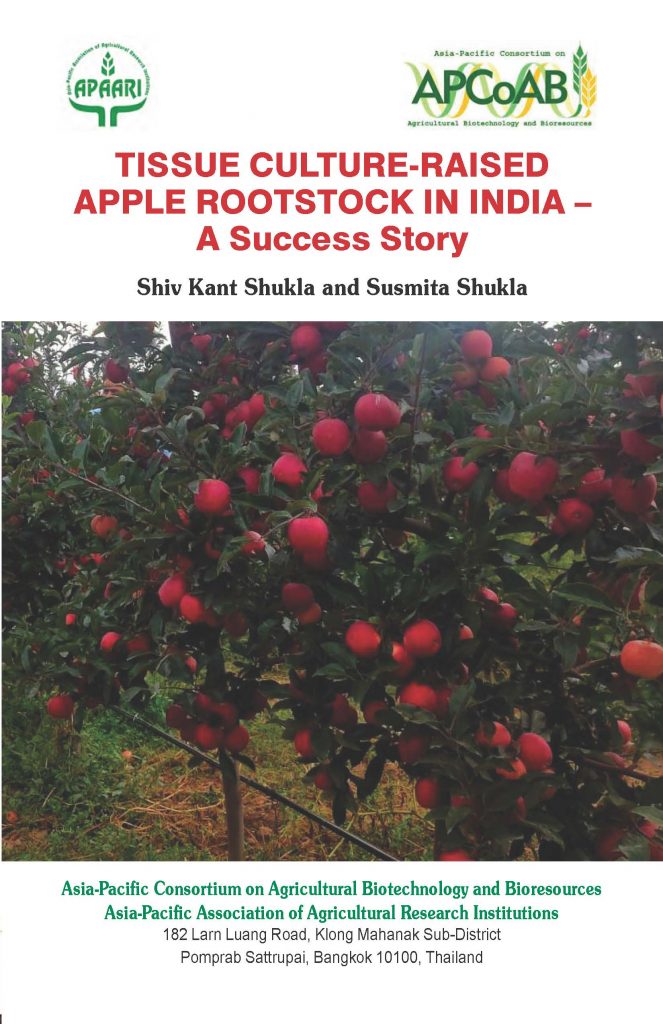 Tissue Culture-Raised Apple Rootstock in India – A Success Story
[download id=”37473″]
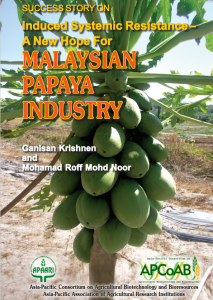 Success Story on Induced Systemic Resistance – A New Hope for Malaysian Papaya Industry
[download id=”36808″]
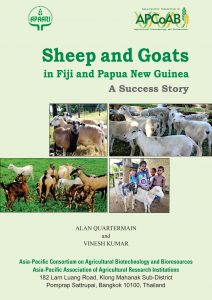 Sheep and Goats in Fiji and PNG – A Success Story
[download id=”36768″]
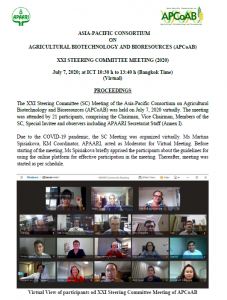 Proceeding of XXI APCoAB Steering Committee Meeting July 2020 Final
 Regional Capacity Building Programme on Biotechnological Tools in Aquatic Genetic Resource Management and Ex Situ Conservation – Online platform
[download id=”36055″]
 Regional Capacity Building Programme on Biotechnological Tools in Aquatic Genetic Resource Management and Ex Situ Conservation – Brochure
[download id=”35713″]
 Regional Workshop on Underutilized Fish and Marine Genetic Resources and Their Amelioration – Country Status Reports
[download id=”35274″]
 Regional Workshop on Underutilized Fish and Marine Genetic Resources and Their Amelioration – Proceedings and Recommendations
[download id=”35376″] 13th International Conference on Development of Drylands: Converting Dryland Areas from Grey into Green – Proceedings
[download id=”31460″]
 APCoAB Brochure 2020
[download id=”34156″]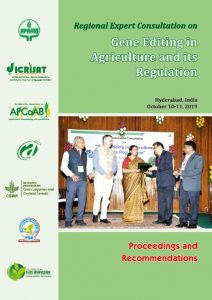 Regional Expert Consultation on Gene Editing in Agriculture and its Regulation – Proceedings and Recommendations
[download id=”33890″]
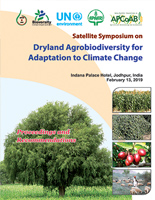 Satellite Symposium on Dryland Agrobiodiversity for Adaption to Climate Change
[download id=”33834″]
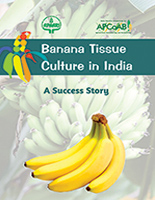 Banana is a highly nutritious and important fruit crop produced by the tropical and subtropical countries
[download id=”33804″]
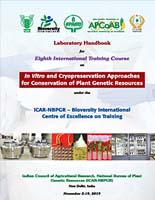 In Vitro and Cryopreservation Approaches for Conservation of Plant Genetic Resources
[download id=”34552″] APCoAB XXth Steering Committee Meeting – Proceedings
[download id=”33779″]
 A compilation of status reports of underutilized animal genetic resources in the various regions of Asia and the Pacific
[download id=”33771″]
International Hands-in Training on Genome Editing Technologies Practical Manual
[download id=”32447″]
 The Regional Workshop on Underutilized Animal Genetic Resources and their Amelioration was held on March 4-6, 2019 at MARDI Headquarters in Serdang, Malaysia.
The III International Symposium on Plant Cryopreservation – Proceedings
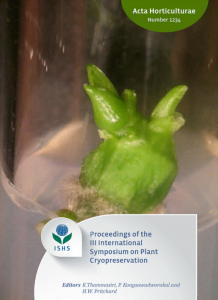 ISHS: The III International Symposium on Plant Cryopreservation – Proceedings
[download id=”32057″]
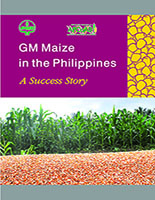
The Philippines has a long history with GM maize having been the first country in Asia to approve a GM crop for use as food and feed with Bt Maize in 2002. The country’s biosafety regulations were implemented in 1990 and investments for infrastructure for biotechnology date as far back as 1979.
[download id=”31941″]
 Regional Expert Consultation on Agricultural Biotechnology – Scoping Partnerships to Improve Livelihoods of Farmers in Asia and The Pacific; Strategic Papers and Country Status Reports
[download id=”31590″]
Regional Expert Consultation on Agricultural Biotechnology – Scoping Partnerships to Improve Livelihoods of Farmers in Asia and The Pacific; Proceedings and Recommendations
[download id=”31587″]
APCoAB XIXth Steering Committee Meeting – Proceedings
[download id=”31464″]
Bt Brinjal from Bangladesh
[download id=”31003″]
 The publication provides a brief account of the mission, objectives, strategy and activities of Asia-pacific Consortium on Agricultural Biotechnology.
[download id=”29673″]
This publication presents the Thematic, Strategic Papers and Country Status Report of the Regional Expert Consultation on Underutilized Crops for Food and Nutritional Security in Asia and the Pacific.
This event was aimed (i) to create awareness on the role and value of underutilized crops which have potential for diversification of food basket to ensure better food and nutritional security in Asia-Pacific region; (ii) to share experiences to accelerate the use of underutilized plants as crops for future and (iii) to assess R&D status on priority crops, and policies that are needed to promote the use of these potential crops for future use in Asia and the Pacific
[download id=”29116″]
 This publication details the proceedings of the Regional Expert Consultation on Underutilized Crops for Food and Nutritional Security in Asia and the Pacific.
This event was aimed (i) to create awareness on the role and value of underutilized crops which have potential for diversification of food basket to ensure better food and nutritional security in Asia-Pacific region; (ii) to share experiences to accelerate the use of underutilized plants as crops for future and (iii) to assess R&D status on priority crops, and policies that are needed to promote the use of these potential crops for future use in Asia and the Pacific.
[download id=”10229″]
 Half-yearly newsletter of the Asia-Pacific Association of Agricultural Research Institutions (APAARI) for the second half of 2017.
[download id=”25808″]
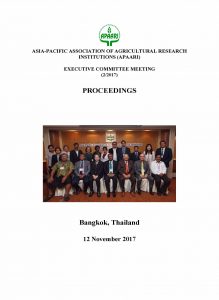 This publication details the proceedings of APAARI’s second Executive Committee Meeting for the year 2017, that was held on 12 November 2017 at Rama Gardens Hotel, Bangkok, Thailand.
[download id=”8945″]
 Half-yearly newsletter of the Asia-Pacific Association of Agricultural Research Institutions (APAARI) for the first half of 2017.
[download id=”4809″]
The Strategic Plan directs APAARI, its partners and other stakeholders to focus on four main themes and their respective outcomes and to contribute to the development of agri-food systems (AFS) in the Asia-Pacific region. These themes are: i) Mobilization, management and use of natural resources for sustainability; ii) Management of risks and uncertainties; iii) Inclusive development and integration of value chains targeted at benefiting smallholders; and iv) Analysis, strengthening and formulation of public policies and overarching regulatory frameworks in support of the transformation and development of AFS.
[download id=”10164″]
 The 1st International Agrobiodiversity Congress held in New Delhi, India, from 6-9 November, 2016 was attended by over 900 participants from 60 countries. Congress delegates discussed various aspects of conservation, management, access and use of agrobiodiversity in 16 technical sessions, four satellite sessions, a genebank roundtable, a public forum, a farmers’ forum and poster sessions. Based on detailed deliberations, the delegates unanimously adopted the following declaration in the concluding session on November 9, 2016.
[download id=”10160″] – November 2016
 This publication encapsulates succinctly the diverse events, scientific deliberations and recommendations that emanated from the 1st International Agrobiodiversity Congress in 2016. The Congress brought together over 1000 experts from over 60 countries covering almost all aspects related to conservation of agrobiodiversity and its enhanced use. These includes: genetic resources, genetic and breeding, biotechnology, human nutrition, ecology and environmental science, information management, bioinformatics, genomics, agronomy, forestry, integrated pest management, conservation biology, law and policy analysis, economics and other social sciences.
[download id=”28549″]
This proceeding emanates from the Awareness Seminar cum Brainstorming Meeting on ‘Access and Benefit Sharing: Striking the Right Balance’ organized jointly by the Organizing Committee of the ‘1st International Agorbiodiversity Congress (IAC 2016)’, Anand and Anand, and the Indian Society for Plant Genetic Resources (ISPGR). It is hoped that his document would be useful to all the stakeholders, especially for shaping the policy, guidelines and procedures related to ABS arising out of agrobiodiversity exchange and use.
[download id=”5934″]
 This framework is designed for research agencies and partners to assist in developing strategies for communicating about Agri-biotechnology. It is based on a workshop on ‘Development of Communication Strategies for Adoption of Agri-Biotechnology in Asia’, held in Chiang Rai, Thailand, from 28-29 September 2015.
[download id=”5428″]
 The publication details of the proceedings of a two day workshop held in Chiang Rai, Thailand, from 28-29 September 2015 to deliberate on key factors that could lead to faster adoption of agri-biotechnology and identify best practices and communication strategies to overcome some of the challenges faced by some countries in adopting agri-biotechnology. The workshop was jointly organised by the Asia Pacific Association of Agricultural Research Institutions; the International Service for the Acquisition of Agri-biotech Applications; Asia-Pacific Consortium on Agricultural Biotechnology and the Malaysian Biotechnology Information Centre, and was supported by the Council of Agriculture Executive, Yuan, R.O.C.
[download id=”5438″]
The publication reports the proceedings of the meeting held at Japan International Research Center for Agricultural Science (JIRCAS), Tsukuba, Japan on 4-5 August 2014. It includes summary of presentations on Keynote Lectures, Country Reports, Scientific Advances in Specific Commodities followed by discussions held in each session. Details of Discussions on Key Issues and Recommendations made in the final session are also provided.
[download id=”9346″]
The publication provides a brief account of the mission, objectives, strategy and activities of Asia-pacific Consortium on Agricultural Biotechnology.
[download id=”5671″]
 This is a rewritten, updated and enlarged version of previous APCoAB publication “Biosafety Regulations of Asia-Pacific Countries”. It gives brief details of the regulatory instruments comprising laws/acts/decrees/regulations/rules related to biosafety of GM crops existing in 48 countries of Asia and the Pacific. The contents comprise chapters: 1) Status of Genetically Modified Crops in Asia-Pacific, 2) International Developments in Biosafety Regulation, 3) Biosafety Regulations in Asia-Pacific Countries, 4) Risk Assessment Frameworks: Some Case Studies, 5) Trade-Related Issues in GM Crops, and 6) Biotechnology and Biosafety in Asia-Pacific – The Way Forward.
[download id=”5479″]
 The publication reports the proceeding of the Asia-Pacific Symposium on Molecular Breeding, held from 1-3 October 2013 at AVRDC-The World Vegetable Centre. The event brought together more than 60 scientists involved with plant and animal breeding from 11 Asia-Pacific countries. The symposium program was divided into three parts: The first part provided a technical update on marker-assisted selection in breeding and on genotyping innovations; the second part reported on the status and the progress of molecular breeding in the countries represented in the symposium; and the final part comprised a networking session designed to build bridges between the research institutions in the region to enhance collaboration in marker-assisted selection for improvement of priority crop and animals.
[download id=”6877″]
 This publication is the outcome of meeting on the same topic organized by Asia-Pacific Consortium on Agricultural Biotechnology (APCoAB) in Bangkok, Thailand on 16-17 April 2013. It includes background information, program, and summaries of presentations, discussion highlights and recommendations. The latter are grouped under these subheads; i) biotechnology R&D priorities especially aimed at smallholders ii) enhancing communication for public awareness, and iii) regional cooperation for biosafety management.
[download id=”6866″]
 The publication details the proceedings of meeting organized by APAARI in collaboration with Indian Council of Agricultural Research (ICAR) at New Delhi on October 10-12, 2012. The contents include recommendations made in seven sessions on Status and Management of Trans-boundary Diseases (TBDs) of plants, animals and fish; Issues on TBDs; and Priorities for Policies, Research and Regional Management of TBDs. The final chapter comprises proceedings of Plenary Session including recommendations on policy, research, capacity building and regional cooperation in management of TBDs.
[download id=”9492″]
 This publication is the outcome of meeting organized by Asia-Pacific Consortium on Agricultural Biotechnology (APCoAB) and Philippine Council for Agriculture, Aquatic and Natural Resources Research and Development (PCAARRD) in Manila, Philippines on 27th September, 2012. It includes summaries of the presentations and recommendations made during the meeting.
[download id=”9506″] This publication details micropropagation protocols of date palm based on somatic embryogenesis and organogenesis and using, besides others tissues, flowers as explants. It also provides information on media supplements and their effects on cultures. Success stories of commercial application of micropropagation in data palm are recounted and suggestions made to enhance adoption of this technology.
[download id=”9509″] The First Global Conference on Women in Agriculture (GCWA) held in New Delhi (13-15 March
2012) was organized by the Indian Council of Agricultural Research (ICAR), the Asia-Pacific Association of Agricultural Research Institutions (APAARI), and was supported by the multistakeholder Global Forum on Agricultural Research (GFAR) through a new mechanism “Gender in Agriculture Partnership (GAP)”. This publication contains a synthesis report on this important event.
[download id=”6938″]
This publication contains background, messages, program of the expert consultation, proceedings and recommendations of the meeting held by APAARI in collaboration with Council of Agriculture, Chinese Taipei at Taiwan Agricultural Research Institute, Taichung during October 27-28, 2011.
[download id=”5683″]
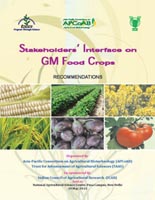 This publication is the outcome of meeting organized by Asia-Pacific Consortium on Agricultural Biotechnology (APCoAB) and Trust for Advancement of Agricultural Sciences (TAAS) with the support of Indian Council of Agricultural Research (ICAR) in New Delhi on 19th May 2011. It includes perspective on the current food needs and agricultural production in India, and recommendations of the interface.
[download id=”7135″]
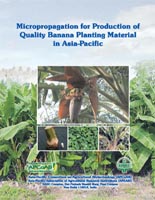 This publication describes the shoot tip culture based banana micropropagation along with other rapid multiplication methods like macropropagation and somatic embryogenesis. It also provides details of common virus diseases of banana, and methods of their diagnosis and elimination. The chapter on Prospects of Banana Micropropagation in Asia-Pacific, details some success stories of adoption of micropropagation based banana planting material at the farmer field level followed by suggestions on the way ahead to enhance its production and adoption.
[download id=”6947″]
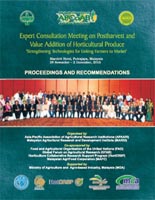 This publication reports the proceedings of expert consultation meeting held by APAARI in collaboration with Malaysian Agricultural Research and Development Institute (MARDI) in Malaysia on 29 November – 2 December 2010. It includes details of presentations and discussion in five technical sessions, and recommendations. Strategies and action plans proposed to address key policy, technical and management issues on post-harvest and value of fruits, vegetables, ornamentals, herbs and medicinal plants with special reference to strengthening linkages of farmers to markets in the Asia-Pacific region are also included.
[download id=”7236″]
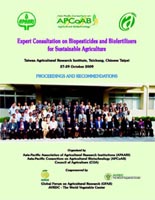
This publication reports the proceedings of the Expert Consultation on Biopesticides and Biofertilizers for Sustainable Agriculture, held at the Taiwan Agricultural Research Institute, Taichung, Taiwan, on October 27-29, 2009.
[download id=”7232″]
This publication details the Proceedings of the Regional Consultation on Crops for the Future: Towards Food, Nutritional, Economic and Environmental Security in the Pacific, organized in Nadi, Fiji Islands, on 21-22 September 2009.
[download id=”30066″]
This publication details the Proceedings of the Expert Consultation on Agricultural Biotechnology for Promoting Food Security in Developing Countries, organized in Kuala Lumpur, Malaysia, on 20-22 August 2008.