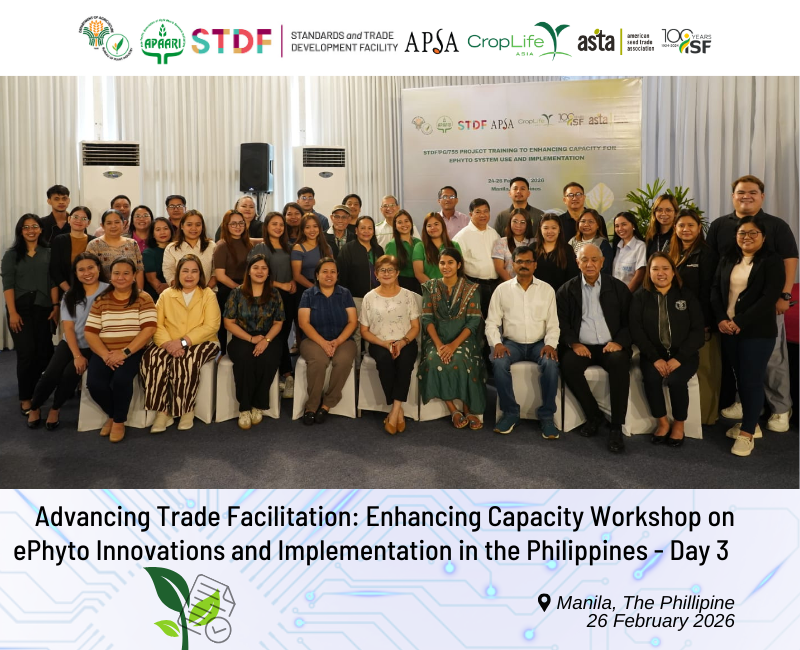
26 February 2026 – Manila, Philippines. A national capacity-building workshop on electronic phytosanitary certification (ePhyto) was successfully conducted in the Philippines from 24–26 February 2026, accelerating the country’s transition toward faster, more efficient digital agricultural trade.
The training, titled “Advancing Trade Facilitation: Enhancing Capacity Workshop on ePhyto Innovations and Implementation in the Philippines,” was organized under the Standards and Trade Development Facility (STDF)-funded project, “Strengthening Phytosanitary Compliance and Public-Private Partnerships to Boost Seed Trade in the Asia-Pacific Region.”
The project is implemented by the Asia-Pacific Association of Agricultural Research Institutions (APAARI), in collaboration with its technical implementing partners: Asia and Pacific Seed Alliance (APSA), International Seed Federation (ISF), American Seed Trade Association (ASTA), and CropLife Asia (CLA).
The workshop provided critical “last-mile” support to ensure that Plant Quarantine Officers and Inspectors from the Bureau of Plant Industry (BPI)—both Regional and Central Offices—along with ICT staff involved in ePhyto operations, exporters of regulated plant commodities, are fully equipped to use the national ePhyto system in day-to-day operations.
APAARI sincerely acknowledges the Bureau of Plant Industry (BPI) for spearheading this initiative and for fostering a strong collaborative partnership with APAARI for the effective implementation of the program.
The three-day program, conducted in both English and the local language, covered:
- An overview of the global ePhyto initiative, the IPPC Hub, and national implementation milestones
- A step-by-step guide on using the ePhyto Web Application (intercommerce.com.ph)
- Defined roles and responsibilities of BPI officers, exporters, and other stakeholders in the application, review, and approval processes
- Handling common system issues, error resolution, and support protocols
- Ensure data integrity, user authentication, and compliance with phytosanitary standards
- Processes for ePhyto exchange through ASEAN Single Window (ASW), the IPPC Hub, and Trade Control and Expert System (TRACES)
- Stakeholder feedback for user interface (UI) improvements and system upgrades
Dr. Rose Souza Richards, Phytosanitary Affairs Manager, International Seed Federation enriched the program through her session on “ePhyto Implementation in Practice: Operational Changes, Pathways, and Lessons Learned,” expressing her appreciation and enthusiasm for supporting the project.
The programme engaged officers and inspectors of the Bureau of Plant Industry, with 32 representatives participating, bringing the total number of participants in that session to 36. It also convened 38 exporters from across the Philippines in one session, with a total participation of 48, and continued with 35 exporters in the final session, reaching a total of 43 participants. Each session also included four participants who joined virtually.
The Philippines continues to position itself as one of ASEAN’s leading adopters of digital phytosanitary certification. Through this STDF-supported initiative, the country is expected to further accelerate regional trade facilitation and strengthen phytosanitary compliance across the Asia-Pacific region.
About the Standards and Trade Development Facility (STDF)
The STDF is a global multi-stakeholder partnership that facilitates safe and inclusive trade. Established by the Food and Agriculture Organization (FAO) of the United Nations, the World Organization for Animal Health (WOAH), the World Bank Group, the World Health Organization (WHO), and the World Trade Organization (WTO), which houses and manages the partnership. In support of the United Nations’ Sustainable Development Goals (SDGs), the STDF responds to evolving SPS needs, drives inclusive trade and contributes to sustainable economic growth, poverty reduction, food security and resilience to climate change.
About the Asia-Pacific Association of Agricultural Research Institutions (APAARI)
Founded in 1990 by the FAO, the Asia-Pacific Association of Agricultural Research Institutions (APAARI) is a membership-based, apolitical, and multi-stakeholder organization that promotes agricultural research and innovation across 21 countries of the Asia-Pacific region. APAARI unites National Agricultural Research Systems (NARS), international research centers, regional and sub-regional for a, universities, NGOs, and private-sector actors from 33 countries. Its mission is to strengthen agri-food research and innovation systems for sustainable development and food security in the region.
Media / Press Contact:
Darshika P. Senadheera
Communication Officer
d.senadheera@apaari.org