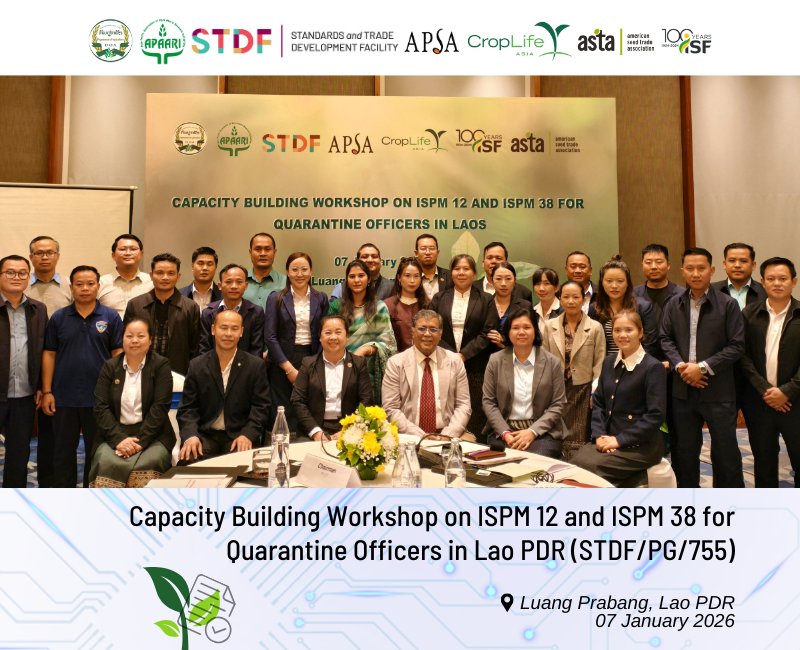
Luang Prabang, Lao PDR | 08 January 2026 – A one-day Capacity Building Workshop on the International Phytosanitary Measures (ISPM), focusing on phytosanitary certification (ISPM 12) and on international movement of seeds (ISPM 38), was successfully organized by the Asia-Pacific Association of Agricultural Research Institutions (APAARI) for 26 public and private stakeholders in Lao PDR.
The workshop was conducted under the Standards and Trade Development Facility (STDF)–funded regional project “Strengthening Phytosanitary Compliance to Boost Seed Trade in the Asia-Pacific.” It brought together 23 quarantine officer representatives of Lao PDR, alongside 2 participants from the private sector and Mrs. Phonethip, Deputy Director General (DDG), Department of Agriculture, Lao PDR.
The primary objective of the workshop was to strengthen national capacity on ISPM 12 and ISPM 38, with a strong focus on the specific operational needs of Lao PDR quarantine officers. A key activity of the workshop was the translation and discussion of the complete ISPM 12 and ISPM 38 guidelines into Laotian, ensuring that international standards are accessible, clearly understood, and practically applicable by national and provincial phytosanitary authorities.
Key Outputs
- Enhanced awareness and technical capacity among Lao PDR stakeholders on seed movement standards (ISPM 38) and phytosanitary certification requirements (ISPM 12).
- Strengthened national phytosanitary systems aligned with international standards.
- Improved capacity to facilitate safe seed trade while ensuring compliance with international phytosanitary requirements.
This effort represents an important step toward reinforcing Lao PDR’s phytosanitary framework and supporting safe, efficient, and internationally compliant seed trade.
About the Standards and Trade Development Facility (STDF)
The STDF is a global multi-stakeholder partnership that facilitates safe and inclusive trade. Established by the Food and Agriculture Organization (FAO) of the United Nations, the World Organisation for Animal Health (WOAH), the World Bank Group, the World Health Organization (WHO), and the World Trade Organization (WTO), which houses and manages the partnership. In support of the United Nations’ Sustainable Development Goals (SDGs), the STDF responds to evolving SPS needs, drives inclusive trade and contributes to sustainable economic growth, poverty reduction, food security and resilience to climate change.
About the Asia-Pacific Association of Agricultural Research Institutions (APAARI)
Founded in 1990 by the FAO, the Asia-Pacific Association of Agricultural Research Institutions (APAARI) is a membership-based, apolitical, and multi-stakeholder organization that promotes agricultural research and innovation across the Asia-Pacific region. APAARI unites National Agricultural Research Systems (NARS), international research centres, universities, NGOs, and private-sector actors from 33 countries. Its mission is to strengthen agri-food research and innovation systems for sustainable development and food security in the region.
Media / Press Contact:
Darshika P. Senadheera
Communication Officer
d.senadheera@apaari.org