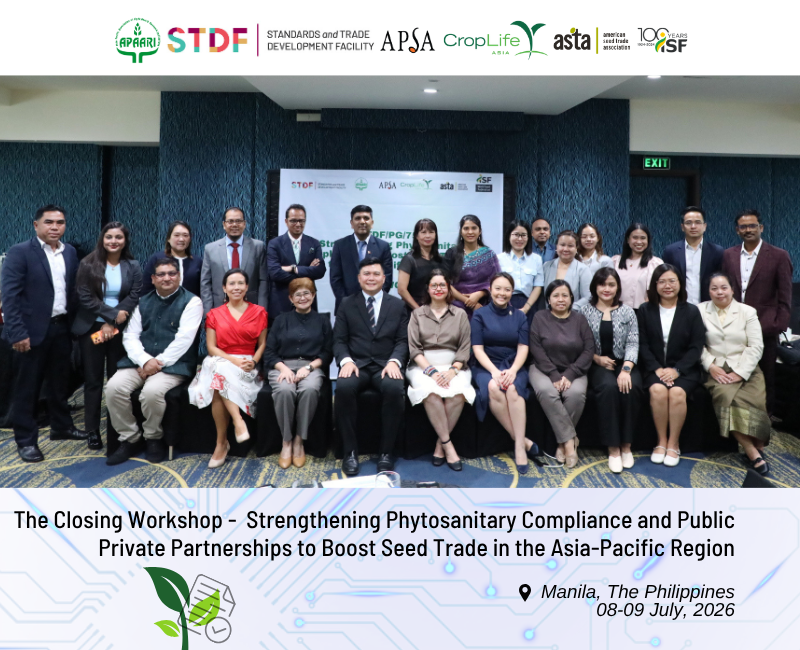
8–9 July 2026, Manila, Philippines — Bangladesh, Cambodia, Lao PDR, Nepal, the Philippines, Thailand, and Viet Nam have strengthened their phytosanitary systems, advanced digital solutions for seed trade, and enhanced collaboration between governments and industry through a three-year project supported by the Standards and Trade Development Facility (STDF). The project trained nearly 400 government officials, supported improvements in regulatory and technical capacities, strengthened implementation of international phytosanitary standards, and developed a regional digital platform to facilitate access to seed trade requirements.
Implemented by the Asia-Pacific Association of Agricultural Research Institutions (APAARI), in collaboration with the International Seed Federation (ISF), the Asia and Pacific Seed Alliance (APSA), CropLife Asia (CLA), and the American Seed Trade Association (ASTA), the regional project, Strengthening Phytosanitary Compliance and Public–Private Partnerships to Boost Seed Trade in the Asia-Pacific Region, has helped the seven participating countries improve their readiness for safe, efficient, and resilient seed trade.
Project achievements, lessons learned and pathways for sustaining results over the long term were highlighted at the Project Closing Workshop, which brought together 17 representatives from National Plant Protection Organizations (NPPOs) from the participating countries, together with representatives from APSA, CLA, ISF, and STDF. Representatives from Bayer Crop Science India and InterCommerce Network Services, Inc., the Philippines also participated.
In her welcome remarks, Ms. Catalina Pulido, Economic Affairs Officer at the Standards and Trade Development Facility (STDF), highlighted the project’s contribution to safe and inclusive trade, in line with STDF’s Strategy, and underscored the growing importance of strengthening phytosanitary capacity to support sustainable agricultural development and regional collaboration.
Setting the stage, Dr. Ravi Khetarpal, Executive Director of APAARI, highlighted the seed trade landscape in the Asia-Pacific region and underscored the importance of the three-year project, which aimed to strengthen phytosanitary compliance and address the challenges faced by developing and least-developed countries in meeting international phytosanitary standards for seed trade. Through technical capacity development, policy support, digitalization, and strengthened public–private partnerships, the initiative has contributed to enhancing the region’s readiness for safe, efficient, and resilient seed trade.
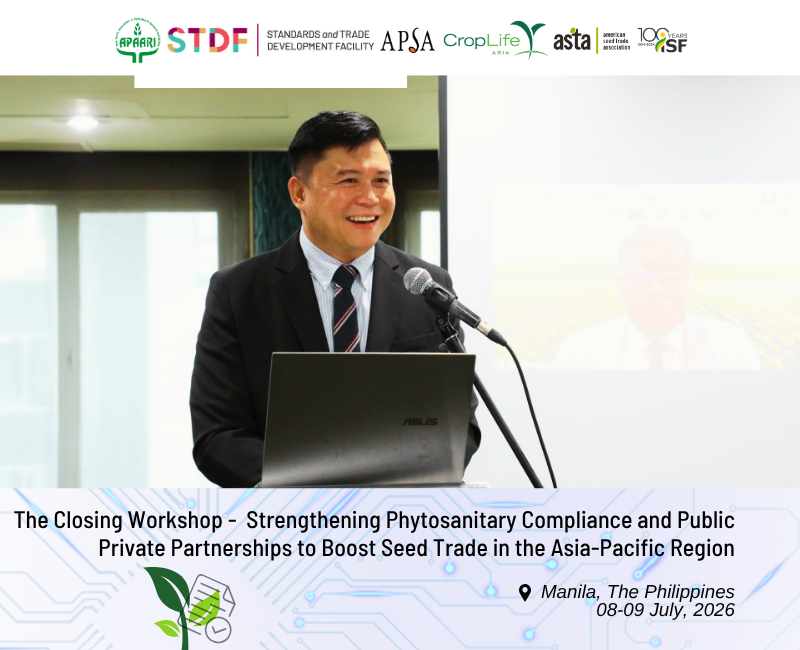
Opening the workshop, Mr. Gerald Glenn F. Panganiban, Director of the Bureau of Plant Industry (BPI), Philippines, emphasized the project’s lasting legacy.
“It may be the end of the project, but it is not the end of the process. This project has provided us with a readiness assessment, a roadmap for strengthening our phytosanitary systems, strengthened our regulatory capacities, and supported our digital transformation through ePhyto certification”.
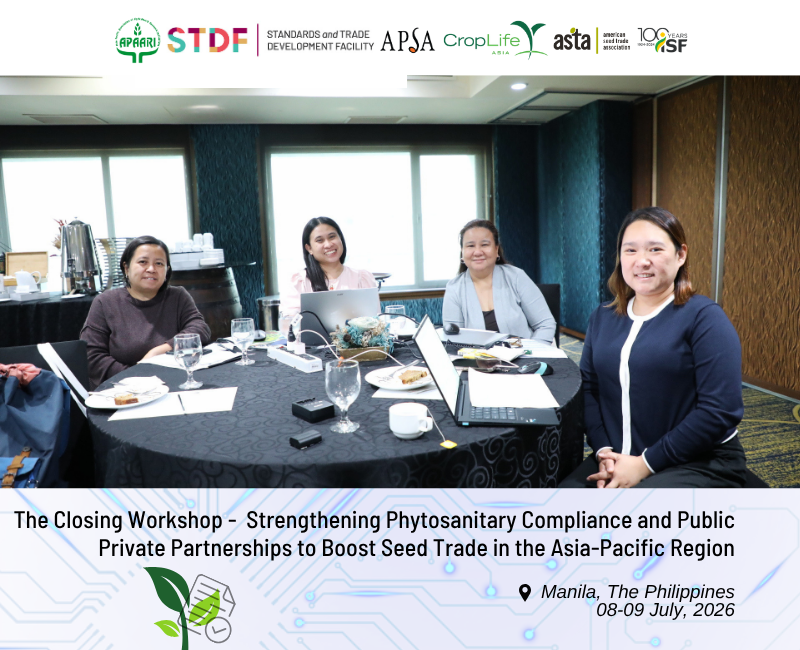
A key focus of the Workshop was reviewing the progress achieved by participating NPPOs over the project’s implementation period. Country presentations compared baseline capacities with current achievements, demonstrating improvements in infrastructure, regulatory and policy frameworks, technical capabilities, and institutional capacity. At the same time, participants acknowledged that significant challenges remain, particularly for least-developed countries where seed companies are missing and proper laboratory facilities are needed for seed health testing.
The workshop also reviewed the ‘Seed Phyto Portal”, a digital platform developed by APAARI and officially handed over to APSA for hosting on its website. Designed to improve access to phytosanitary regulations and facilitate regional seed trade, the portal will serve as a practical resource for both National Plant Protection Organizations (NPPOs) and the seed industry. Participants emphasized that its long-term effectiveness will depend on regular updates by designated national focal points and sustained commitment from participating countries.
Highlighting the private sector’s role in ensuring the portal’s sustainability, Ms. Francine Sayoc, Executive Secretary of APSA, stated:
“Our focus is not only on keeping the portal updated, but also on how effectively we, as the private seed sector, promote it to seed companies. We want the Seed Phyto Portal to be actively used by the private sector, and that is a key metric we want to track.”
Strengthening Public–Public and Public–Private Partnerships was another major theme of the workshop. Participants recognized the APSA Phytosanitary Expert Consultation as an effective platform for dialogue, trust-building, and coordinated action between governments and the private sector.
Reflecting on the Philippine experience, Mrs. John May R. Tolentino, Chief of the National Plant Quarantine Services Division, Bureau of Plant Industry, Philippines, highlighted the value of sustained collaboration.
“Our partnership with CropLife Asia and the Philippine Seed Industry Association has been essential. Regular quarterly meetings help us understand the private sector’s needs, identify opportunities for collaboration, and work together toward our shared goals. Many of our achievements would not have been possible without their support.”
Reviewing the project’s implementation, Ms. Homaira Jahan Sonom, Associate Project Manager, APAARI noted that the initiative trained more than 395 government officials from the seven participating countries while integrating cross-cutting priorities such as gender and environmental sustainability. Reflecting on the project’s long-term impact, she said:
“Our hope is that each person trained throughout this project will carry this knowledge back to their organization, ensuring that the benefits of this project continue to grow long after the trainings have ended.”
Dr. Rosineide Souza Richards, Director of Phytosanitary Affairs and Seed-Related Innovations at ISF, was one of the project’s key technical implementing partners throughout its implementation. During discussions on sustaining private-sector engagement and investment, she emphasized that trust is the cornerstone of successful public–private partnerships.
“The private sector needs to engage with NPPOs in a transparent way. The clearer and more open we are, the easier it becomes to build trust and collaborate. Institutionalizing public–private partnerships begin with listening to each other, building relationships, and developing trust before formalizing them through legal agreements.”
The workshop also reviewed progress in strengthening countries’ understanding and implementation of the International Standards for Phytosanitary Measures (ISPMs), presented country-specific sustainability plans, and shared recommendations from an independent external evaluation to guide future improvements.
Closing the workshop, Dr. Ravi Khetarpal, Executive Director of APAARI, reaffirmed the APAARI’s commitment to supporting participating countries beyond the project’s lifetime.
“Each of the participating countries is an APAARI member. It therefore becomes APAARI’s responsibility to remain engaged with them and monitor the project’s outputs and outcomes beyond its lifespan. We will continue supporting these National Plant Protection Organizations (NPPOs) and replicate successful approaches through future projects.”
He also highlighted the key innovations developed through the project and outlined plans to scale them up with the support of the Technical Implementing Partners as part of the project’s sustainability plan.
About the Standards and Trade Development Facility (STDF)
The Standards and Trade Development Facility (STDF) is a global partnership that supports developing countries in improving their sanitary and phytosanitary (SPS) capacity to facilitate safe trade, improve food security, and promote sustainable economic development.
About the Asia-Pacific Association of Agricultural Research Institutions (APAARI)
Founded in 1990 by FAO, the Asia-Pacific Association of Agricultural Research Institutions (APAARI) is a membership-based, apolitical, and multi-stakeholder organization that promotes agricultural research and innovation across the Asia-Pacific region. APAARI brings together National Agricultural Research Systems (NARS), international research centres, regional and sub-regional fora, universities, NGOs, and private sector actors. Its mission is to strengthen agri-food research and innovation systems for sustainable development and food security in the region.