13 November 2026 | Khon Kaen and Maha Sarakham, Thailand
The Asia-Pacific Association of Agricultural Research Institutions (APAARI), through its involvement in the Greater Mekong Subregion Cross-Border Livestock Health and Value Chains Improvement Project (CLHVCIP), participated in a series of technical study visits to livestock research institutions in northeastern Thailand from 12–14 November 2026. The visits brought together representatives from the Department of Livestock and Fisheries (DLF), Lao People’s Democratic Republic (Lao PDR), and the CS03 project team to exchange technical knowledge and explore opportunities for strengthening livestock research and development in Lao PDR.
Representing APAARI, Dr. Thumrongsakd Phonbumrung, Team Leader of the CLHVCIP-CS02 Consultancy, joined the delegation for the visits, which focused on learning from Thailand’s experience in livestock breeding, artificial insemination, animal nutrition, and forage seed production.
Technical Study Visits to Livestock Research Institutions
As part of the programme on 13 November 2026, the delegation visited four livestock research institutions in northeastern Thailand to gain practical insights into their technical operations, facilities, and research practices.
The institutions visited included:
- Northeastern Bovine Semen Production and Research Center – The delegation learned about bovine semen collection, processing, storage, and quality control.
- Khon Kaen Artificial Insemination and Biotechnology Research Center – Discussions focused on artificial insemination (AI) services, biotechnology applications, and liquid nitrogen management.
- Ruminant Feed Research and Development Center – The visit provided insights into animal feed analysis, laboratory testing, and quality standards.
- Mahasarakham Animal Nutrition Research and Development Center – The delegation explored forage crop seed production, processing, laboratory testing, and quality control practices.
The programme also included discussions on cattle production systems and breeding strategies adopted in Thailand and tropical regions, providing opportunities to exchange experiences and explore approaches relevant to the livestock sector in Lao PDR.
Knowledge Exchange on Integrated Forage Crop Seed Production
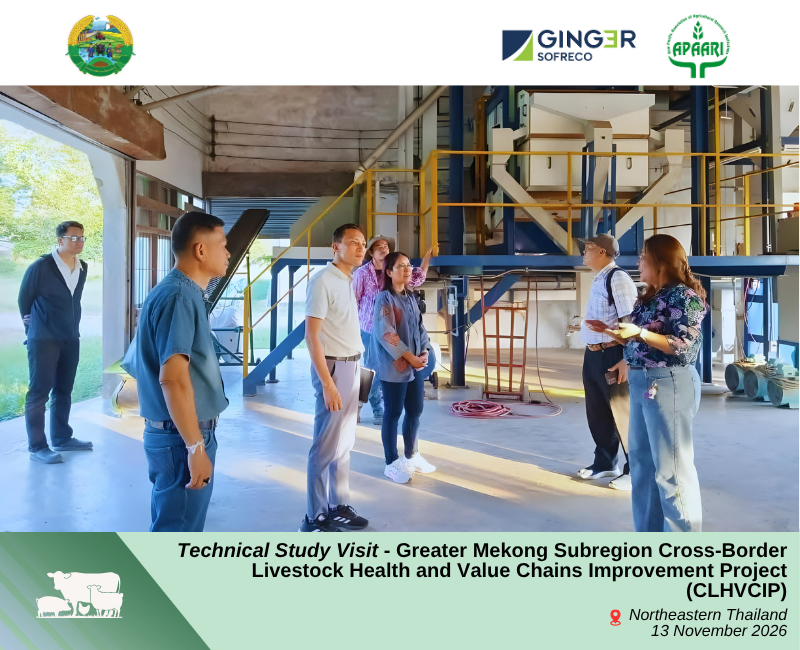
A dedicated technical knowledge-exchange visit was also conducted at the Mahasarakham Animal Nutrition Research and Development Center on 13 November 2026 at 3:30 PM.
The delegation was welcomed by Ms. Sasithorn Jorjong, Director of the Centre, together with its officials. The visiting delegation included Dr. Thumrongsakd Phonbumrung and Dr. Thansamay Vorlaphim, accompanied by officials from the Department of Livestock and Fisheries, Lao PDR.
The session focused on exchanging knowledge and practical experiences on the integrated production of forage crop seeds, with particular attention to seed production techniques and quality assurance.
During the visit, the delegation toured the Centre’s forage seed processing facility, where they learned about seed conditioning and processing operations. The programme also included visits to the forage seed quality testing laboratory and the temperature- and humidity-controlled seed storage facilities, providing insights into seed testing, quality management, and appropriate storage practices.
The exchange aimed to strengthen technical understanding and promote continued academic and institutional cooperation between Thailand and Lao PDR in forage seed production and management.
Strengthening Regional Knowledge Exchange and Collaboration
The technical study visits provided valuable opportunities for the Lao PDR delegation to learn from Thailand’s institutional expertise, research facilities, and practical experiences in livestock development. The knowledge gained is expected to contribute to identifying relevant approaches for strengthening livestock breeding, artificial insemination services, forage development, and laboratory capacities in Lao PDR.
Through CLHVCIP, APAARI contributes to critical skills development and policy support under the CS02 consultancy, facilitating technical cooperation and knowledge exchange to support improvements in livestock health, food safety, and livestock value chains.
The visits highlighted the importance of regional partnerships, institutional collaboration, and sharing practical knowledge in addressing common livestock development challenges across the Greater Mekong Subregion.
Media / Press Contact:
Darshika P. Senadheera
Communication Officer
d.senadheera@apaari.org